
To set up an appointment to have your pet neutered or to learn more about this procedure, please call or visit our clinic. If you are struggling with the decision of whether to neuter your pet, please call us so we can discuss your concerns.
Neutering
Neutering your pet has many benefits. The procedure, which prevents male animals from reproducing, can help your dog or cat live a longer, healthier life. Neutering will not change your pet’s personality.
By neutering your pet, you’re reducing or eliminating his risk for prostate and testicular cancer, as well as sexually transmitted diseases. Neutering will also reduce or eliminate undesirable and embarrassing behavior, including roaming, fighting, humping, and spraying. In addition, neutering your pet will help control the dog and cat overpopulation problem, keeping more animals out of shelters.
Neutering, which involves removing the testicles, is a surgical procedure and does need to be performed with the pet under anesthesia. We follow strict protocols and continually monitor your pet’s vital signs to help ensure his safety. Please see the descriptions under Anesthesia and Patient Monitoring for more information on what we do to keep your pet safe.
Questions about Spaying or Neutering Your Pet?
The Benefits of Spaying and Neutering Pets
We recommend that all dogs and cats be spayed and neutered, preferably before reaching adulthood. Here are some of the most important ways spay and neuter surgeries benefit male and female dogs and cats:
Spaying (Females)
- Eliminates the heat cycle for good
- Prevents the development of ovarian and uterine cancer
- Reduces the risk of mammary gland tumors
- Prevents a serious infection of the uterus known as pyometra
- Reduces or prevents entirely such behaviors as roaming and vocalizing
Neutering (Males)
- Can prevent aggression stemming from high testosterone
- Reduces or prevents roaming, urine marking/spraying, mounting
- Prevents the development of testicular cancer
- Reduces the risk of prostate issues
Additional Information
When should you spay and neuter your pets?
- Appointments Required (Available Monday-Friday)
- Pet should be at least 6 months of age and/or the appropriate weight (Spay/ Neuter)
- Drop off time is between 6:30 am to 8:00 am with an appointment
- Please allow at least a half-hour to discuss and sign all surgical authorizations with a trained technician.
Pre-Surgical Instructions
- Please do not allow the pet to eat or drink past 10 pm the evening before surgery
- If your pet is in heat or pregnant the surgery can be done, but there is an additional charge
- All pets must be current on the following vaccines and tests:
- Rabies
- Bordetella (within the last 6 months)
- Negative fecal test (within the last year)
- DHPP/DHLPP (dogs)
- Influenza (dogs)
- FVRCP (cats)

Spay & Neuter Options
To ensure the safest and most effective surgical experience for your pet, we include several important components as part of our surgical protocol. Such as:
- IV Catheter [included with surgery]
- A Complete Blood Count (CBC) [Allows our veterinarians to catch any underlying issues that may cause complications for surgery]
- Pre-Surgical Panel (For pets less than 5 years of age)
- Comprehensive Plus Panel (For pets 5+ years of age)
- Absorbable sutures [Fall out naturally and there is no need to come back for suture removal
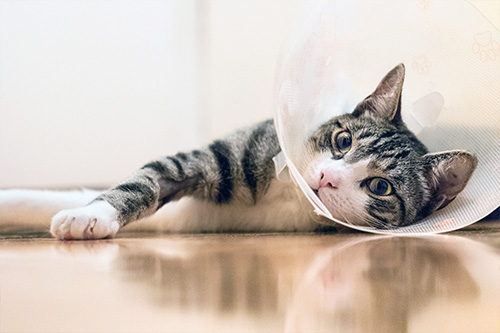
- Elizabethan Collar (The Cone of Shame) [Prevents pet from licking the incision site and creating infections]
- Microchip
- Post-Operative Pain Management
- Electrocardiogram (ECG) [Evaluates cardiac function prior to surgery to determine if the patient is fit for anesthesia]
- Chest X-Rays (strongly recommended for pets over 7 years) [Can identify underlying heart and lung disease]
- Laser Therapy [Helps manage pain and inflammation to assist in the healing process]
- Overnight Care Package [Includes additional pain injection, extended monitoring, complimentary overnight stay, and post-operative laser therapy]
Aftercare for Spaying and Neutering
Following surgery, please withhold all food and water until 8 a.m. the next day to help prevent complications as your pet recovers from anesthesia. For the next 14 days, it’s important to limit high-activity behaviors such as running, climbing, or jumping to support a full recovery. During this time, your pet should be leash-walked only—even in your own backyard.
If you’ve opted for an e-collar, ensure your pet wears it continuously for the entire two-week period. If they struggle to eat or drink with it on, it’s okay to remove the collar during meals, but be sure to supervise closely. Our team will provide detailed, personalized care and medication instructions at checkout to guide you through the recovery process.
Common Myths About Spaying and Neutering Pets
There are several misconceptions about spaying and neutering still circulating today.
While there certainly are costs with every spay and neuter procedure, the overall cost is generally far less than that of raising a litter or paying for your pet’s cancer treatments. It’s a one-time payment, and will minimize all your pet’s reproductive risks.
There is no evidence supporting this claim. In fact, going through their heat cycle and having a litter is likely to increase your pet’s chances of getting cancer later. We recommend spaying dogs and cats before they have their first heat cycle, because this lowers their cancer risks considerably. Mammary gland tumors have a high rate of malignancy in cats, and a 50% malignancy rate in dogs.
Your pet’s metabolism will slow down when they reach adulthood, but spaying and neutering do not contribute to obesity in pets. Weight gain is usually the result of overfeeding/overindulging and not keeping your pet active. As long as they’re on a balanced diet and getting regular exercise, their weight should stay in a healthy range.